
Marching from Kandy to Belém for the sovereignty of peoples and Buen Vivir
10 November 2025
Solidarity with the Venezuelan people
12 November 2025
From March to October 2025, during our International Action Year, we were united through the slogan Marching against wars and capitalism, defending the sovereignty of peoples and Buen Vivir. Therefore, the 24 delegates from our movement who were part of the 3rd Nyéléni Global Forum headed to Kandy following successive actions in their own territories. These women are from all regions of the world: Sri Lanka, Indonesia, the Philippines, India, Nepal, Türkiye, Kenya, Benin, Brazil, Chile, Peru, Macedonia, Georgia, Algeria, Tunisia and the United States.
Our action slogan not only aims to connect us, but also to remind us that no one is free until we are all free. As the genocide against the Palesitianian people streches for over two years, and massacres in Sudan, Congo, Afghanistan, Haiti and in so many territories spread and make people´s daily lives precarious, solidarity is indispensable for our struggle. For personal testimonies and stories from our comrades in Palestine, take a look and share our Palestinian Booklet published early this year.
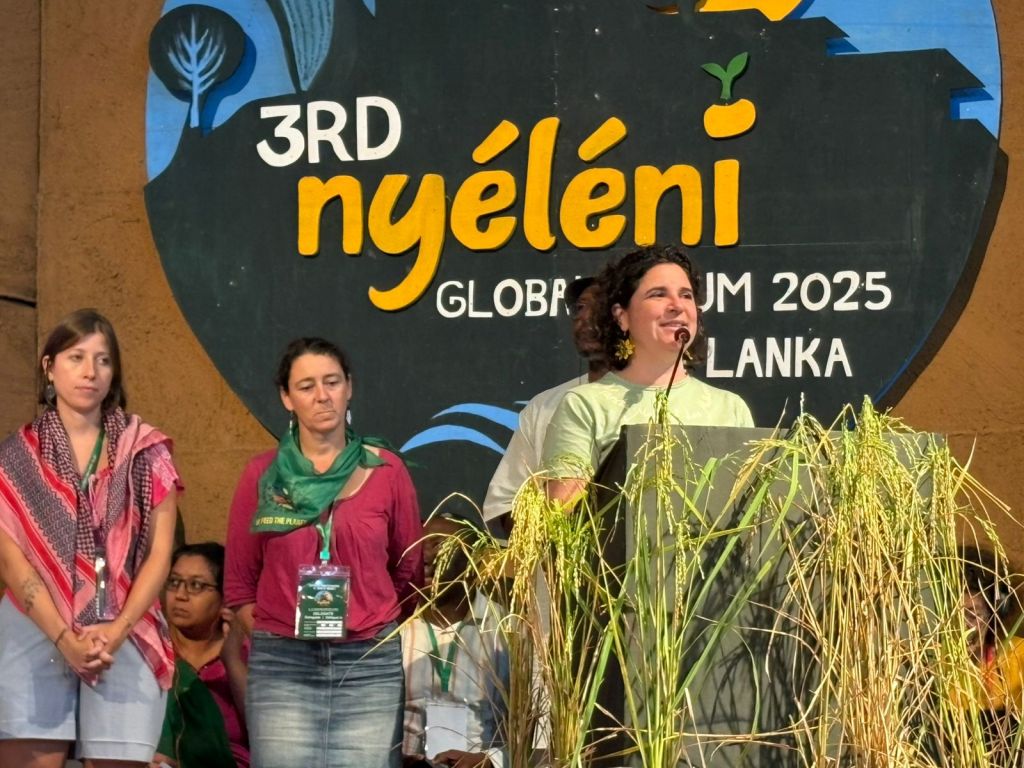
The delegates from WMW Americas Mafalda Galdames, Sarah Luiza Moreira, and Kelly Gutierrez, wrote a key piece in preparation for the Forum: "World March of Women: on the road to food sovereignty". There, they say:
"It has been an important and ongoing struggle to assert the intrinsic link between food sovereignty and feminism. Historically, women have been responsible for ensuring food security within families, communities, and societies, yet their knowledge and traditional practices have often been overlooked. Feminist movements continue to challenge and fight against the sexual and racial division of labor, which has overburdened women’s bodies and harmed our health."
The Nyéléni Global Forum was introduced in the text published yesterday, and now we´ll share details of the days in Kandy, Sri Lanka. On September 6th and 7th, 2025, the days prior to the Forum, our delegates participated in the Diversities and Youth Assemblies and organized the Women´s Assembly together with comrades from La Via Campesina, Friends of the Earth, People´s Health Movement, World Forum of Fisher Peoples, International Indian Treaty Council and Intercontinental Network for the Promotion of Social Solidarity Economy. The Assemblies were powerful moments of preparation, convergence and building unity, popular action and struggle. There, we could discuss our grassroots, feminist and antiracist proposals to the Common Political Action Agenda (CPAA).
In its 3rd edition, 60% of participants in Nyéléni were women, which endorses how women are in the frontline and that there is no food sovereignty without women´s work and autonomy. However, as most of the work done by women is still invisibilized, in the Women´s Assembly the delegates reinforced the need to recognize as farmers, fishers, pastoralists, and labourers in the struggle against patriarchal capitalism. After speeches from the movements abovementioned on their contributions to the CPAA, the delegates present were divided in groups to collectively answer the question: how can we make feminism central for the systemic transformation we want to build? The delegates talked about diverse issues such as access to land and rights, violence, debt, about ways of placing life and care at the center of our system and so much more. To read more on the Women´s Assembly of the 3rd Nyéléni Global Forum read this article from Capire written by Bianca Pessoa from Brazil, part of our communication team:Women’s Assembly of the 3rd Nyéléni Forum: “Building the Future To Transform the World”. Also, you can access the pictures of the Forum here!
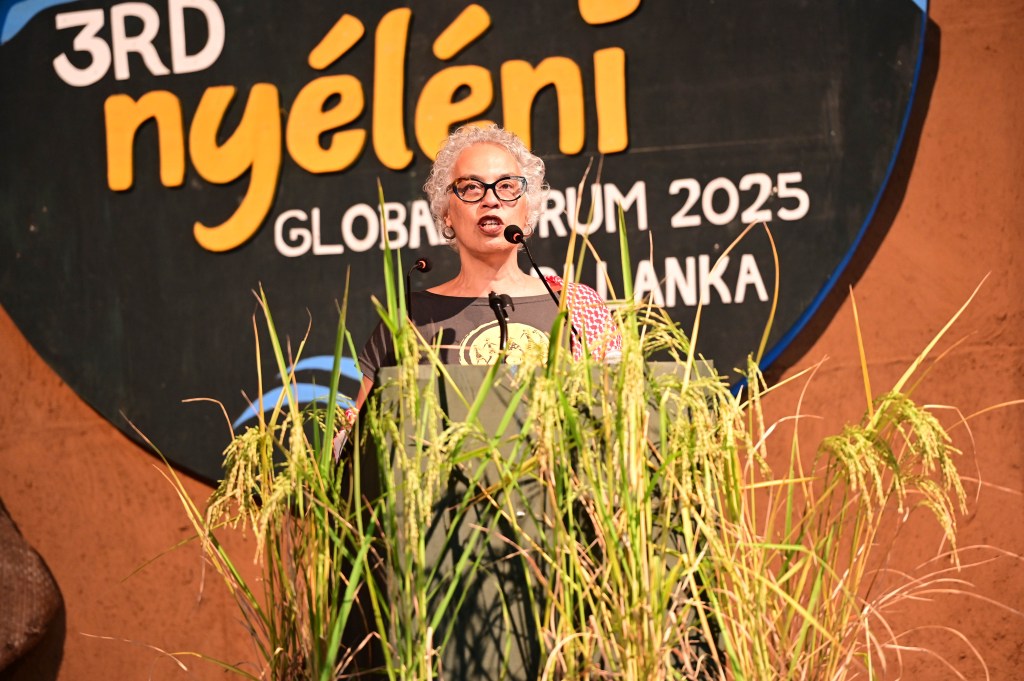
On the first day of the Forum, September 8th, we celebrated the opening ceremony and Miriam Nobre, coordinator of SOF/Brazil and member of the WMW, who was part of the coordination committee for the Forum in Mali, was one of the speakers. She recalled the 70th anniversary of the Bandung Conference, and highlighted the achievements of the struggle for food sovereignty within the feminist movement in articulating issues that affect women's lives, whether in rural or urban contexts. Regarding current challenges, she shared how resistance to neoliberal individualism and the construction of diverse and inclusive communities is a task for all people within their movements. Food and care are collective responsibilities that should be practiced in communities, against the neoliberal individualism. This paragraph was also written by Bianca Pessoa in SOF and is available in Portuguese.
Miriam thanked the people of Sri Lanka for their hospitality in welcoming so many people to their land with halapa, a dish prepared with local millet, highlighting the resistance of the peoples who continue to cultivate their traditional crops and resist herbicides. The struggles upheld by women from Sri Lanka are relentless and admirable. In the beginning of the year, through the preparations for the 3rd Nyéléni, the World March of Women met the members of Women´s Collective and formed a National Coordinating Body (NCB) in the country. Now, Gayani Gomes is the coordinator and she tells us:
"In Sri Lanka, the NCB of the World March of Women brings together diverse women’s movements rooted in struggles for labour rights, peace, and food sovereignty. Through the Nyéléni process, we strengthened the Women’s Collective — uniting rural, plantation, and Free Trade Zone women to connect feminist economy and food sovereignty as one struggle. From Nyéléni, we march together with renewed strength, grounding our local resistances in global feminist solidarity.”
We have a lot to learn from the people of Sri Lanka, who protested united against and overthrew an authoritarian and corrupt government that led the country, in the end of 2022, to its biggest economic crisis. It´s been 60 years that Sri Lanka has taken loans from the IMF and World Bank. In total, 17 were taken. The new government is from the left for the first time in decades, but contrary to promises, still follows a similar economic trajectory from previous ones. But the people know their power and how it's for them the government needs to rule.
Sri Lanka has been colonized by the Portuguese, Dutch and the British. Colonization influenced the local Singalese, Tamil and Muslim identities, and with the independence from the British in 1948, the Singalese in the government expelled the Tamils from their land with violence. Some decades later happened the so-called 'green revolution', which led native rice to be substituted by the genetically modified ones sold by private companies. The story is too long for a few lines, but it´s important to say that Sri Lanka would produce their own food if it were not for economic liberalization and wars.
Until 2009, Sri Lanka lived a decades-long civil war and genocide against the Tamil people, who still today face militarization in the areas they live. Gayani Gomes also shared in the virtual meeting Who Wins a War? Imperialism and the Arms Industry that feminism is women´s main tool to build peace. She reinforced that the lack of wars doesn't mean peace. In the north and east of the island, thousands of women were forcibly displaced, became widows and had to take care of the family alone. These women face multiple violences - worringly high cases of sexual violence - and have not been represented in discussions for peace. After the war in 2009, feminist organizations played a key role in documenting cases and violations, crucial for practising truth and keeping memory, such as the ongoing struggle of mothers and daughters to find disappeared people by the State during the war. Anuka de Silva, from La Via Campesina and the Coordination Committee of Nyéléni, shared in the opening speech of the Women´s Assembly that;
"Sri Lanka's economy is driven by women, but no one recognises this. On farms, it is women who do the heavy work without receiving good wages. Similarly, women in garment factories are living in very difficult conditions, without decent wages, without a life. There is a lot of violence in industrial areas. And also domestic workers, many women migrate to the Middle East to be domestic workers."
Regarding the space of the Forum, it´s interesting to know that the venue in Kandy - the NICD (National Institute of Cooperative Development) - had been abandoned for five years and there was a plan to privatize it. With Nyéléni, however, the large area with multiple conference rooms, halls, sleeping rooms, kitchens and auditoriums was revitalized and can now be used once again as a training and meeting center for the people.
Nyéléni makes visible the connections between our struggles. In Sri Lanka, farmers - and mostly women - are persuaded by foreign microfinance companies to take loans that seem inoffensive when officers arrive at their doors. But these companies take advantage of their lack of financial education and by not sharing all the information create a cycle of debt. Only in 2022, 200 people in the country, again mostly women, committed suicide because they were stuck in debts brought by microfinance companies. During the Forum we discussed the increasing debt, be it on the national, community or individual levels, and our delegates reinforced how the majority of borrowers are women as well as the different ways this leads to further precarization of life. Daya Laxmi Shrestha, International Committee Member and Coordinator of Nepal NCB, tells us about the struggle of Nepalese women against microfinance:
"Resisting microfinance in Nepal is not merely about rejecting loans—it is about confronting the structural violence that traps rural women in cycles of debt, shame, and dependency under the false promise of “empowerment.” What is framed as inclusion often becomes a new mechanism of exclusion, where women’s unpaid labor, social capital, and collective trust are monetized to sustain profit-driven financial institutions. True feminist transformation begins when women reclaim control over their resources, knowledge, and decision-making—beyond the logic of credit and repayment. By rejecting the microfinance model and advancing food sovereignty, cooperative economies, and communal self-reliance, rural women are not just resisting exploitation—they are redefining empowerment itself, rebuilding solidarity, and asserting their right to live and produce with dignity and autonomy."
It's important to identify the commonalities in our struggles so we can become stronger together, and international gatherings such as Nyéléni are very important for this. Our comrade Susan, from WMW Indonesia and KIARA shares with us her feelings and hopes:
"Attending the Nyéléni Global Forum was an honor. I learned about collective struggle at the grassroots level, the colors of people's movement initiatives, and the meaning of dignity. At the Nyéléni Global Forum, I understood better about the process of collective struggle and gained a deeper understanding about what sisterhood is about. I believe that people's movements must continue to be strengthened through solidarity. I believe that people's movements should not be limited to sectoral matters. I believe that standing up and taking part in people's movements is the most honorable choice rather than surrender to the failed system. The Nyéléni Global Forum gives us two choices: whether we take a bow to the failed system itself, or we get involved in transforming and creating a new system that is anti-capitalist, anti-patriarchal, anti-fascist, and anti-imperialist. The choice is always there, and I choose to keep on marching and upholding the transformation for a better system."
During the days of the forum, the global movements had two moments to meet, and we gathered in the auditorium to discuss our contributions to the final document of the CPAA. One of those was brought forward in the first meeting, as we sat in a circle, by Sheelu Francis from India NCB and Women's Collective: the importance of recognizing rights and works of women farmers. She shares how the "recognition of women as farmers is a long standing demand because the lack of land ownership and tenure leads many of them not to have formal land titles. Even when it´s their labour, they may not control land or income. Without this, access to credit and subsidies is difficult. Policies sometimes nominally include women but operational modalities (e.g. subsidy allocations, identity documents, modes of delivery) may exclude or make it hard for women to benefit. Access to inputs, infrastructure and technology, such as tools, machinery, storage, markets, digital tools etc, must be accessible and appropriate for women. We also always have to link this overburden with gender roles and the care work that sustains the system". Sheelu shared more about this article from Capire.
It was also discussed how it's important to connect food sovereignty to broader struggles of human rights, like sexual and reproductive rights and the right to self-determination. Our comrade Fatou Samba, also member of the International Coordinating Committee of LVC representing West and Central Africa, highlighted the urgency of ending genital mutilation of women and children and child marriage. These cruel practices aim to control girls' sexuality and are exacerbated in times of war. They can result in death due to overbleeding and lead to lifelong pains and wounds.
As parts of the CPAA on militarization and wars were discussed in between our delegates, another contribution was reinforced: the importance of guaranteeing migrants and refugee´s rights to residence after crossing borders, ending the Kafala system of the Gulf countries and temporary labor programs for migrant workers - since under this type of contracts migrants are denied basic rights and dignity. Our comrade Tara Villalba from Community To Community in the United States compliments on this from her territory:
"The Trump administration has militarized the Immigration and Customs Enforcement (ICE) Agency to terrorize and forcibly remove members of the immigrant, migrant, and refugee communities in the USA. They scapegoat immigrants, especially undocumented workers, as the cause for the inequality that exists today. Rather than respecting farmworkers, paying them a living wage, enforcing labor protections, and providing healthcare, US industrial farmers prefer to lower wages and exploit workers, to extract higher profits for themselves. The H-2A Program is an agricultural temporary labor visa program that allows farmers to hire and import foreign farmworkers as a cheap, exploitable labor force. Workers suffer wage theft, denial of healthcare, inhumane living conditions, and they are entirely isolated from the local community, as they are forced to live behind chainlink fences. H-2A workers’ visas are held at the mercy of their employers, discouraging workers from speaking up about abuses. The H-2A program also displaces local immigrant farmworkers, who increasingly struggle to find work and make ends meet. Temporary labor programs like the H2A agricultural program treats workers as disposable, and is built to abuse and impoverish farmworkers. The H2A program is touted to be a solution to an alleged worker shortage. The reality is that it harms both the temporary workers, as well as the local farmworkers already working."
Our comrade Joanne Cheung from APEN Action, also from the United States, reminds us that: “The power of the people is stronger than any regime or billionaire president.” This feeling was felt in the halls of the Forum. Another important point emphasized by Innocencia Guedegbe from the International Committee and Benin NCB is on the difference between food security and sovereignty and their effects in the current system:
"Food security happens when human beings have access to sufficient, safe, and nutritious food to meet their energy needs and dietary preferences. But food sovereignty is much broader: it aims to reduce dependence on imports and large industrial structures. It enables communities to practice agriculture using local knowledge and promoting natural and cultural resources. So while food security, which is part of a neoliberal framework, prioritizes large-scale production, commercial distribution, and corporate involvement to increase global food availability, food sovereignty consists of producing what is needed to feed the population and prioritizes local, community-controlled food systems."
We also discussed how grassroot feminist communication is part of our politics, an strategy of our movement to dispute for hegemony and worldviews and is based on contextualized knowledge, on diversity, and on the feminist insurgence, as written by Tica Moreno in Doing Grassroots Feminist Communication, Facing Digital Capitalism in Capire. This is why we say that everyone can be a communicator: it´s not only a technical subject nor exclusive to specialists. It must be organic and collective, in the networks, fields and streets. In this way, recognizing ourselves as political subjects is revolutionary. Our comrade Kelly Gutierrez from Peru shares beautiful words from her territory:
"I am from the Andes, and for us women in rural areas, there is a very profound truth: our bodies are the first territory we defend. From our Andean worldview, Pachamama has great significance in our lives and development; she teaches us the relationship between nature, care, and existence itself. Caring for the earth is also caring for ourselves, because our bodies and territories are united by the same energy of life. Our struggle is not only to resist, but to build a world where life is above capital. Even if we are threatened or criminalized, we remain firm, raising our voices. We want to educate, share, and sow social justice in our territories. We know that to achieve this we need sisterhood among the women of the world, a strong feminist alliance that unites our struggles and our dreams. We also believe in solidarity economies for life. We want to produce our food organically, care for our families and the earth with agroecological practices, with healthy and sustainable livestock farming. These simple forms of work and care challenge the system that only seeks to exploit nature and our bodies. We demonstrate that another way of living and producing is possible. Care becomes collective resistance; we care for each other, we organize, we share our struggles and our joys. From this encounter comes the strength that keeps us standing, that we are not alone: every woman who resists is part of an alliance that sustains life. From Nyéléni, we affirm that we are guardians of ancestral memory and that our strength comes from the roots we share with the earth. In every seed, in every story told by our grandmothers, we recognize the wisdom that teaches us to live in balance, with sisterhood and equality. Defending that memory is defending the future: where the earth and our bodies are not commodities, but sacred spaces of life, freedom, and dignity, where we are recognized as subjects of rights, not as objects of the system, and as builders of justice and hope for the peoples."
We also discussed how grassroot feminist communication is part of our politics, an strategy of our movement to dispute for hegemony and worldviews and is based on contextualized knowledge, on diversity, and on the feminist insurgence, as written by Tica Moreno in Doing Grassroots Feminist Communication, Facing Digital Capitalism in Capire. This is why we say that everyone can be a communicator: it´s not only a technical subject nor exclusive to specialists. It must be organic and collective, in the networks, fields and streets. In this way, recognizing ourselves as political subjects is revolutionary. Our comrade Kelly Gutierrez from Peru shares beautiful words from her territory:
"I am from the Andes, and for us women in rural areas, there is a very profound truth: our bodies are the first territory we defend. From our Andean worldview, Pachamama has great significance in our lives and development; she teaches us the relationship between nature, care, and existence itself. Caring for the earth is also caring for ourselves, because our bodies and territories are united by the same energy of life. Our struggle is not only to resist, but to build a world where life is above capital. Even if we are threatened or criminalized, we remain firm, raising our voices. We want to educate, share, and sow social justice in our territories. We know that to achieve this we need sisterhood among the women of the world, a strong feminist alliance that unites our struggles and our dreams. We also believe in solidarity economies for life. We want to produce our food organically, care for our families and the earth with agroecological practices, with healthy and sustainable livestock farming. These simple forms of work and care challenge the system that only seeks to exploit nature and our bodies. We demonstrate that another way of living and producing is possible. Care becomes collective resistance; we care for each other, we organize, we share our struggles and our joys. From this encounter comes the strength that keeps us standing, that we are not alone: every woman who resists is part of an alliance that sustains life. From Nyéléni, we affirm that we are guardians of ancestral memory and that our strength comes from the roots we share with the earth. In every seed, in every story told by our grandmothers, we recognize the wisdom that teaches us to live in balance, with sisterhood and equality. Defending that memory is defending the future: where the earth and our bodies are not commodities, but sacred spaces of life, freedom, and dignity, where we are recognized as subjects of rights, not as objects of the system, and as builders of justice and hope for the peoples."
In the World March of Women we are made up mostly of rural, peasant, young urban and professional women. Promoting the socialization of domestic labor and care work is our political duty, as is to encourage participation from community kitchens, gardens, laundries and other collective initiatives. Mafalda, Sarah and Kelly continue by listing some of our practical actions in this trajectory:
"Transmitting ancestral knowledge on how to cultivate home gardens; defending native and heirloom seeds; encouraging the exchange of products between peasant and small-scale producers; supporting local markets; preserving seasonal foods and promoting the production of handmade textiles. All of this is part of a cycle that requires care for nature and its biodiversity, including mountains, rivers, lakes, and seas, as well as the protection of life, health, and the body-territory of women."
However, the right over our bodies and territories is taken from us when we´re denied the right of abortion and decision over motherhood, and also when pesticides and genetically modified (GMO) seeds are imposed by private companies who promise more production and hide the destruction caused in the whole ecosystem by those chemicals. Natasha from the International Committee and Macedonia NCB shares with us the effects of this practice:
"Pesticides are silently poisoning our lands, our food, and our bodies — especially the bodies of women, children, and those living near agricultural zones. As the National Coordinating Body of the World March of Women in North Macedonia, we have worked on public awareness campaigns in the region of Resen — the country’s largest apple-producing area, but tragically also the region with the highest number of cancer patients, particularly men suffering from lung cancer. According to the Institute for Public Health, this alarming reality is directly linked to the intensive use of pesticides. Our struggle is not only to expose this contamination but to reclaim the right to live free from toxic chemicals, to protect the soil as a living being — and ourselves as part of it."
Another devastating system worldwide is extractivism. The right over our bodies and territories is also taken when mining companies arrive without any dialogue with the local community. Özlem Akkayalı from Türkiye NCB and Kazdağı Association for the Preservation of Natural and Cultural Resources shared about the impact of mining in her territory
"In the Kazdağı region, women stand at the frontlines of resistance against mining projects that threaten our forests, water sources, and the very breath of life. When mining companies arrive, men are often persuaded to sell their lands and move to the cities — a pattern that reflects both economic pressure and patriarchal norms. Yet women stay and resist. They know that the destruction of the earth is also the destruction of their own bodies — the contamination of water, the loss of soil, and the poisoning of air directly affect their health, their children, and their livelihoods. Through solidarity networks, village assemblies, and daily acts of care and defiance, women in Kazdağı defend the land as an extension of their own bodies — nurturing life, protecting memory, and sowing hope against extractivism."
We do not believe in a single feminism, but in many feminisms, each shaped by ideological currents that are deeply connected to territories, identities, Indigenous peoples, and the diverse cultural backgrounds of the women who form our movements. Like this, the feminism that unites us defends food sovereignty, agroecology, feminist economics and territorial struggles. Feminist Economy has been developed within class-conscious and popular feminism, reinforcing the intersections between these different feminist perspectives—class feminism, popular feminism, and community feminism. We also stand against extractivism and the capitalist-patriarchal systems that prioritize profit over life. These systems exploit nature relentlessly, extracting wealth without regard for sustainability or future generations. Our comrade Mafalda from Chile tells us more about the Forum:
"Eighteen years after the 1st Nyéléni Global Forum, which marked a path towards the struggle of peoples for food sovereignty, we are once again gathering, this time in the city of Kandy, Sri Lanka. The conditions of stay and reception of the organizations were exceptional, and we extend our sincere appreciation for the efforts made by their leaders and authorities, who did everything in their power to fulfill the call and objectives of the Forum, which hosted 102 participating countries and more than 700 participants. The delegations came from all continents and the Region of the Americas, which had been working in coordination since the meeting held in the city of Santiago, Chile, where we formed the Alliance for Food Sovereignty in Latin America and the Caribbean, participated with more than 60 delegates and played a prominent role in the Steering Committee, in the working committees, and in the coordination of the Forum.
These were intense days of debates, discussions, and meetings between delegations on thematic areas and global and regional movements, which kept us constantly busy. The field visit was one of the most interesting activities, in which farmers from various localities welcomed the delegations who came to learn about their territorial experiences. There were also fair spaces with local enterprises selling their products and cultural activities offered by artistic groups from Sri Lanka. From the World March of Women, we presented proposals that we considered relevant for the region and for the continuation of the global struggle for the defense of food sovereignty of peoples, which are: International action against hunger and wars; to establish a global Nyéléni day; training school on popular feminism, diversity, and care; restore and establish dialogue with trade union movements; build assemblies in networks and with social movements at the People's Summits (COP30); debates on popular multiculturalism and develop and strengthen popular education from the territories."
Masnu´ah from Puspita Bahari/the Indonesian Fisherwomen's Sisterhood (PPNI) and Indonesia NCB shares her perceptions of those days and a note of hope:
"Nyéléni strengthened solidarity among grassroot movements on a global level, from Nyéléni I learned a lot of things: knowledge, resilience, solidarity and to connect with another alliance in order to grow together and take care of each other. Indonesian Fisherwomen will keep on fighting and organize grassroot movement, especially fisherwomen who stand in the frontline for fighting injustice, patriarchy, and violence caused by government policy. We will continue to multiply our action in protecting our home, our ocean, our mangroves as our life resources for our children and grandchildren in the future. Long live women who fight. Long live our struggles!"
Having in mind the People´s Summit of the COP30 starting tomorrow, our comrade Sophie Ogutu from the International Committee and Kenya NCB continues with this breath of hope and resistance:
"From Nyéléni to the People’s Summit towards COP30, grassroots feminists are rising to reclaim climate justice through food sovereignty, collective care, and the power of organized communities. Reminding the world that women of the land, forests, and waters carry the pulse of resistance, and that true climate action grows from the ground up. Our united voices will echo across continents — affirming that this path to climate justice is feminist, decolonial, and rooted in the struggles of the people."

Our comrade Sarah Luiza from Brazil also shares how this hope is transformed into practice:
“For us, the Nyéléni process continues with the strengthening of our alliances with partner movements in the daily struggle for systemic change, from our territories to the transformation of the capitalist, patriarchal, racist, and LGBTphobic system in which we live. Internally, we will continue our processes of collective training and mobilization around the agenda of food sovereignty, agroecology, and feminist economy to build, starting now, the new world we want!”
Importantly, Susan from Indonesia NCB and KIARA , alerts us about the situation movements will face in COP30, and shares struggles from her territory:
"Climate negotiations keep on going every year, but there is no progressive change for fisherfolk life especially for fisherwomen in Indonesia. The future of at least 3,9 millions fisherwomen in Indonesia were discussed by only representatives of our state but there's no concrete effort from our government on how to mitigate and adapt to the impact of the climate crisis. Climate negotiation this year has become a space for capitalism and imperialism to give orders about state orientation under the climate agenda. This situation has become an important matter for the fisherwomen movement, we believe all the fisherwomen must make noise and scream about the silent majority in many coastal villages in Indonesia who keep on dealing with flood and disaster every year.
Regarding the climate negotiations this year, we the fisherwomen would like to remind Indonesian government and other state leaders that we don’t need false solution such as 30x30, Debt for Nature Swap, Marine Protected Area which managed by INGO Eco Fascist, Carbon Trading or any other false agenda. What fisherwomen need is real effort from our governments to protect and take care of our ocean. We urge our government to stop mega development which is extractive and exploitative. Don't let our ocean become the new business for capitalism. We need clean and healthy oceans, and for this we need our oceans to be protected. "
Surely, sharing connections between local struggles can make us stronger. Ravedee, our comrade from WFFP Thailand shares from the consultation processes among the women fishers movement and WMW:
"Following Nyéléni Forum, the Sustainable Development Foundation (SDF) reaffirms its strong commitment to continue advocating for the recognition and protection of traditional fishers’ rights as a foundation for ensuring food sovereignty, social justice, and the sustainability of marine and coastal resource management. We will further strengthen collaboration with small-scale fishing communities, women fishers, and partner networks WFFP to "Say No " to aquaculture investment and advocate to secure community-based tenure rights, promote inclusive governance, and safeguard the ecological balance that sustains local livelihoods for present and future generations."
Also Marika Kapanadze, our comrade from Georgia NCB, shares plans from her organization:
"For us, the Nyéléni process is a powerful space to strengthen alliances and deepen our shared struggles for food sovereignty. We’ll continue organizing meetings with local communities, promoting agroecology and agrobiodiversity as tools for autonomy, and defending territories from agribusiness expansion. We are committed to amplifying grassroots voices, protecting and revitalizing traditional knowledge, conserving endemic varieties and seeds and building collective strategies that put people and the planet at the center of our food systems."
Masnu´ah from Indonesia NCB denounces the extractive and exploitative projects carried out by governments who will be taking part in the COP30, and relates this to threats in her territory. It´s another important alert as we prepare for the People´s Summit:
"While the world leaders discuss the future of our mothers earth at COP30, fisherwomen in Indonesia have to face extreme weather every day. We face flooding that happens more often nowadays, the heat of the sun which makes us feel like living in the oven, or even strong wind which makes our boat hit the dock concrete; but we are still consistent to fight and defend ourselves to have a better life. In COP 30, our future will be discussed by the representatives who might have never experienced flooding. Our future will be discussed and put at stake in political climate lobbying, year after year discussed but with no significant change to our lives. Our hopes seem so simple, but for the government or world leaders it seems so difficult to implement. Don't let fisherwomen keep on drowning in the flood every year. Therefore, we demand our government and world leaders to end the extractive and exploitative projects that could drown the fisherwomen, our children and our future generation"
To conclude this collective prose, our comrade Margaret Masudio from Esaff Uganda shares words that witness, boldly, today´s times:
"We want to build a strong movement from local, national, regional and global levels that walk in a joint political action agenda to resist fascism, neoliberalism, patriarchal and oppression while defending people's rights to food, food sovereignty and agroecology. Agroecology is beyond just farming but a solution to achieve climate justice, environmental justice and food sovereignty. Food is not a weapon and must not be used as a weapon to end human life. We need systemic transformation now."
Throughout these pages we aimed to tell parts of the 3rd Nyéléni Global Forum through experiences, denouncements and announcements from our comrades, in preparation of the People's Summit of COP30 that's beginning tomorrow.
Without feminism and solidarity, there is no agroecology! Without feminism and solidarity, there is no systemic transformation!
Nyéléni continues, now and forever, until we are all free!
Discover more from World March of Women
Subscribe to get the latest posts sent to your email.


